Hi, I am Lorenzo 👋 I am a new principal investigator at the Paris Brain Institute and CNRS. I am broadly interested in how the structural and functional properties of the neural code support cognitive computation, a question I approach through data analysis, simulations, and mathematical modeling.
I received my Ph.D. in Statistical Physics from École Normale Supérieure and worked as a postdoctoral scientist at the Institut Pasteur and the Center for Theoretical Neuroscience at Columbia University.
My recent work focuses on the geometry of neural representations, specifically how it provides a computational substrate for cognitive processes such as memory and abstraction (see, e.g., my work on social memory [Neuron 2024] and emotional states [Nat Neurosci 2026]), and how single-neuron properties influence population coding and vice versa (see my work on categorical representations along the cortical hierarchy [Nature 2026]).
Before that, I mainly worked on statistical inference and attractor models, specifically to investigate how memorized cognitive maps are retrieved from sensory cues [PLoS CB 2018] and how similar environments are pattern-separated in the hippocampus [Neuron 2020].
If you are interested in working with me, get in touch for opportunities on all levels at the Paris Brain Institute, including master’s internships, research assistant, PhD thesis (Sorbonne graduate program), and Postdoc.


(all kinds of brains!)
Selected Works
See my CV or Google Scholar for the full publications list; the artworks below are from Matteo Farinella
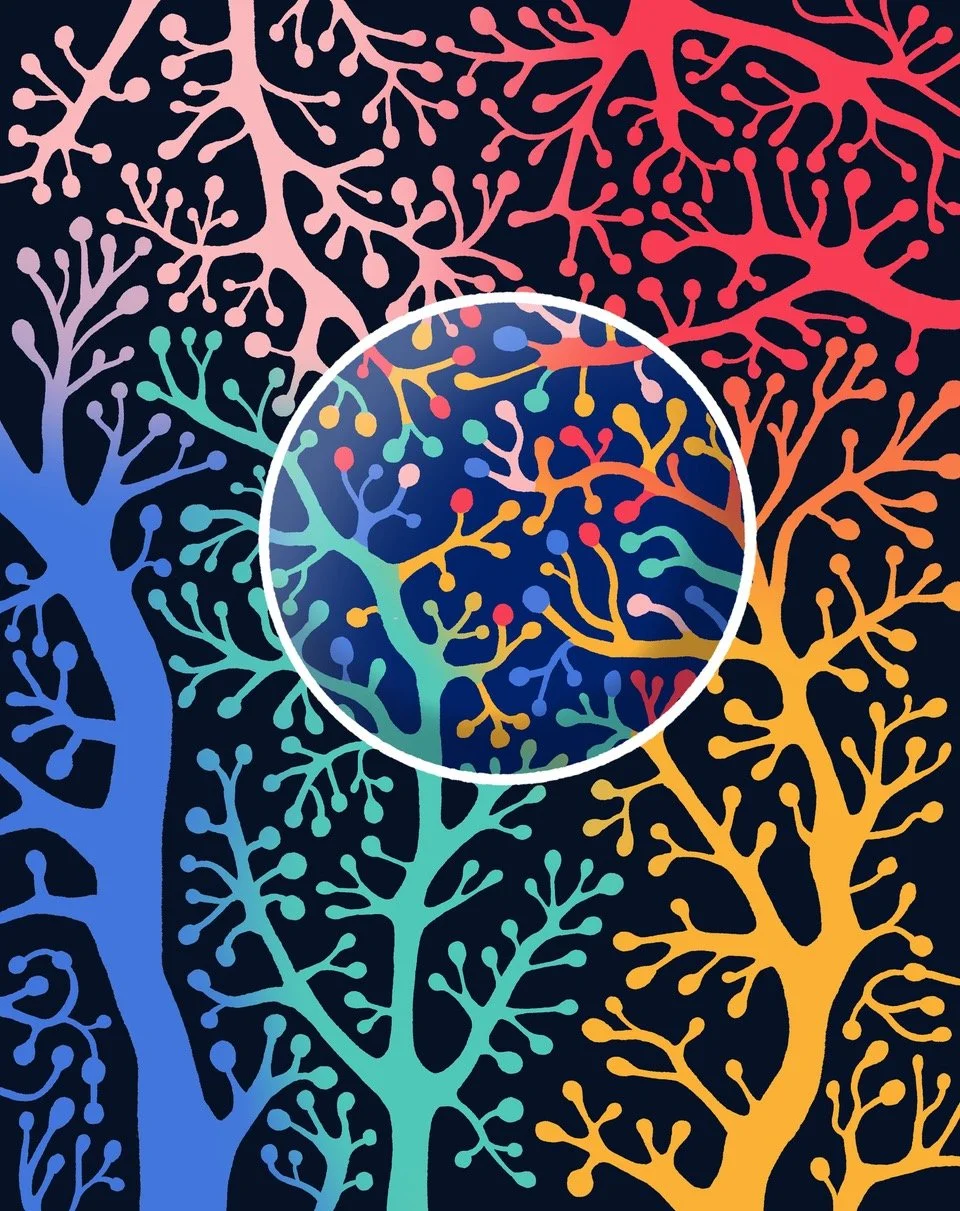
Rarely categorical, highly separable representations along the cortical hierarchy
L Posani*, S Wang*, S Muscinelli, L Paninski, S Fusi
Nature (2026) in press
Press: The Transmitter

Tuned geometries of hippocampal representations meet the computational demands of social memory
L Boyle*, L Posani*, S Irfan, SA Siegelbaum, S Fusi
Neuron (2024) on the cover! ☝️
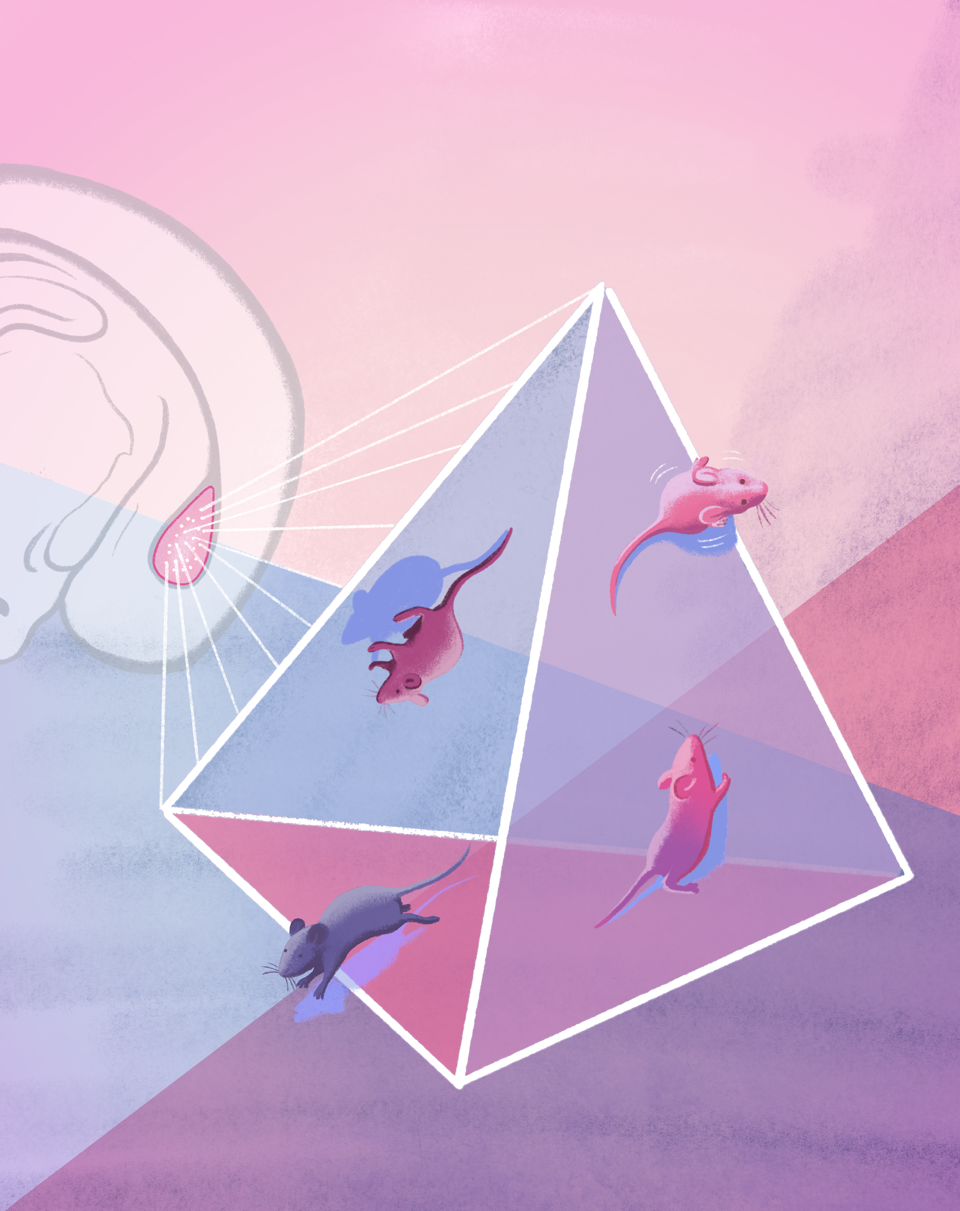
The representational geometry of emotional states in basolateral amygdala
PK O'Neill*, L Posani*, J Meszaros, P Warren, CE Schoonover, A JP Fink, S Fusi, CD Salzman
Nature Neuroscience (2026)
Software & Resources
See also my Resources page
Decodanda is a Python package designed to expose a user-friendly and flexible interface for population activity decoding, avoiding the most common pitfalls through a series of built-in best practices.
Colab Notebook: Neural Geometry
Material for the 2024 course on the Geometry of Neural Representations (part of Columbia’s graduate course in Advanced Topics in Theoretical Neuroscience)
Colab Notebook: The Art of Decoding Neural Representations
Material for the 2022 course on Neural Decoding (part of Columbia’s graduate course in Advanced Topics in Theoretical Neuroscience):